
Key Points
- Tech neck is neck and shoulder strain caused by spending too much time looking down at phones, tablets, or computers. Text thumb is pain and stiffness in the thumb or wrist from repetitive scrolling, texting, and gaming.
- Kids and teens are most at risk since their bones are still developing. The sooner these issues are treated, the better the results — but chiropractic care can help at any age.
- Chiropractic care is a safe, effective way to treat tech neck and text thumb. It relieves discomfort, improves posture, and helps protect your spine for the future.
Screens are part of nearly every moment of our modern life — from school assignments and work projects to scrolling, gaming, and catching up with friends. But all that time looking down or tapping away comes with a price. Two of the most common issues we’re seeing today are tech neck and text thumb, both linked to how our bodies respond to too much screen time.
Table of Contents:
- The Hidden Impact of Daily Screen Time
- What Is Tech Neck?
- What Is Text Thumb?
- Why Kids and Teens Are Most at Risk for Tech Neck and Text Thumb
- How Tech Neck Affects Adults
- How Chiropractic Care Helps Tech Neck and Text Thumb
- Simple Habits to Prevent Tech Neck and Text Thumb
- Relief Made Simple
- References
The Hidden Impact of Daily Screen Time
From the phone in your pocket to the laptop on your desk, screens shape how we live and work. While technology has made life easier, it’s also introduced new strains on the body. Enter the aptly named tech neck and text thumb. Tech neck and text thumb often start small, but the strain adds up over time.
- Tech neck happens when your head is pulled forward and down for long periods, straining your neck and shoulders.
- Text thumb is the overuse of thumb tendons from endless scrolling, texting, and gaming.
These problems are more than just minor annoyances. Left unchecked, they can affect posture, mobility, and quality of life — especially for kids and teens whose bones are still developing. The earlier they’re addressed, the more lasting the results.
At Simply Southern Chiropractic Center, we see patients of all ages — from kids just getting their first phone to adults who spend their days behind a computer. And here’s what we’ve learned: the sooner you address these problems, the better the outcome.
What Is Tech Neck?
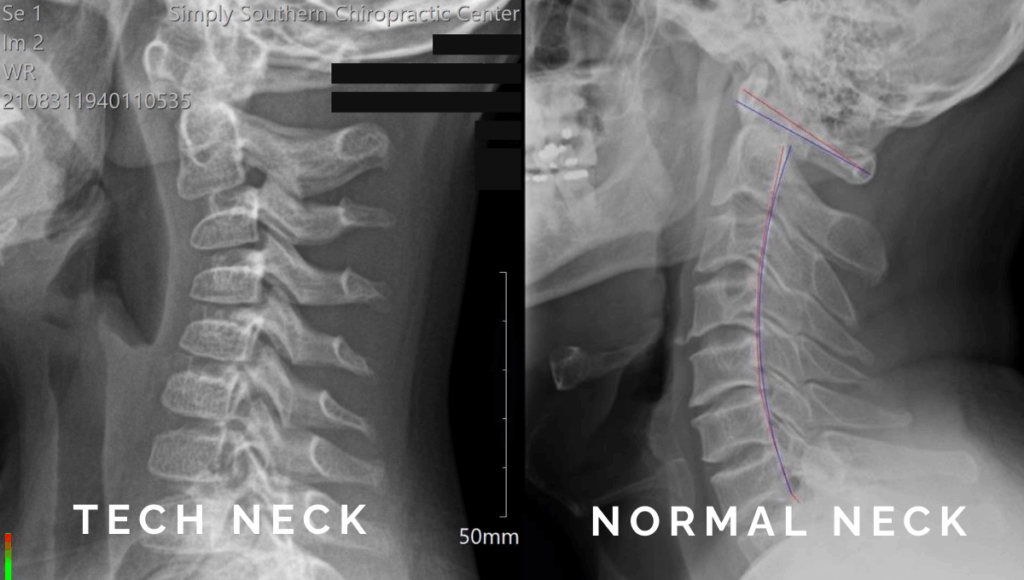
You’ve been sitting at your desk all day, shoulders hunched, eyes glued to the screen. By mid-afternoon, your neck feels stiff, your shoulders ache, and you have a slight headache starting. You catch yourself rubbing your neck and shoulders just to get a little relief. That’s tech neck in action.
When your head tilts forward (like when you check your phone or work on your laptop), it puts extra weight and pressure on the spine. Instead of your neck carrying the normal load of about 10–12 pounds, the strain can jump to 40 pounds or more, depending on the angle. That’s a lot of extra weight! Over time, that stress can:
- Flatten the natural curve of your neck, making it harder for your spine to do its job.
- Overwork the muscles in your shoulders and upper back, leaving them tight, sore, and tired.
- Cause stiffness, tension headaches, and even pain that travels down into your arms, the kind that sneaks up on you after a long day.
For kids and teens, this forward head posture can actually change the way the spine develops. For adults, it often shows up as nagging soreness, poor posture, and fatigue after long hours at a desk.
The important thing to know is this: tech neck doesn’t happen overnight. It builds up little by little, and that’s why early awareness (and small changes in posture) can make such a big difference.
What Is Text Thumb?
If your thumb feels sore after a long stretch of texting or scrolling, you’re certainly not the only one. This modern condition, often called “text thumb,” happens when the tendons in the thumb and wrist are overworked from repetitive movements.
The thumb isn’t designed for hours of rapid tapping and swiping. When we push it past its limits, the tendons can become irritated, leading to:
- Aching or sharp pain in the thumb or wrist
- Swelling or stiffness around the joint
- Weakened grip strength (struggling to open jars or hold objects)
It’s common in teens who make their phones part of just about everything they do, but plenty of adults feel it too — especially those who spend downtime scrolling or gaming. Over time, text thumb can make everyday tasks uncomfortable and even interfere with work or hobbies.
The good news is that it can be managed and, in many cases, prevented with the right care, stretches, and (you guessed it) a little less screen time.
Why Kids and Teens Are Most at Risk for Tech Neck and Text Thumb
Kids today are connected to screens in ways their parents never were — school assignments, social media, gaming, even TV often happens on a tablet or phone. All that looking down might seem harmless in the moment, but it adds up, especially while their bodies are still developing.
The truth is, age makes a big difference in how tech neck and text thumb can be corrected. Here’s what that looks like:
- Kids (under 12 for girls, under 15 for boys): At this age, bones are still growing and flexible — which means the spine can be guided back into a healthy, natural curve more easily. With chiropractic care plus small changes at home (like raising screens and building in breaks), we can set them up for long-term posture success.
- Teens & young adults (15–25): By this stage, the spine has developed more, so it can’t be fully “reset.” But the good news is there’s still plenty we can do. Adjustments help reduce discomfort, release tension, and restore mobility. And with consistent care, we can retrain posture habits, making this a powerful time to minimize strain and prevent bigger problems later.
- Adults (25+): Once the spine is fully grown, the focus shifts to relief. At this point, we can’t turn back the clock. However, chiropractic care helps relieve stiffness, improve mobility, and stop misalignment from progressing — so adults can stay as active, comfortable, and pain-free as possible.
The key takeaway? The earlier these patterns are caught, the better the results. But no matter your age, there’s always something we can do to help you feel better today and protect your spine for the future.
How Tech Neck Affects Adults
You might not think of yourself as someone with “tech neck,” but look at your routine: hours at a desk, phone in hand between tasks, maybe some late-night scrolling before bed. Even if your spine developed normally before screens took over, those everyday habits can still leave you with a stiff neck, tired shoulders, or headaches that creep in as the day goes on. It’s the slow, steady wear of poor posture — and it adds up.
Here’s how tech neck often shows up in adults:
- Stiff or achy shoulders and neck, especially after long hours at a desk
- Headaches that build as the day wears on
- Limited mobility, feeling “stuck” when turning your head
- That heavy, slouched feeling from carrying your head forward all day
Neck pain, stiffness, and headaches may feel like part of your daily routine, but they don’t have to be. Chiropractic care offers a way forward, and most adults are surprised at how much lighter and more comfortable they feel after only a few gentle adjustments.
How Chiropractic Care Helps Tech Neck and Text Thumb
When it comes to tech neck and text thumb, chiropractic care isn’t just helpful — it’s one of the most effective ways to lessen strain, improve posture, and keep problems from coming back. Instead of being a quick fix, chiropractic care addresses the root of the issue by restoring healthy movement in the spine and joints. The result? You feel better day to day, and you’re also protecting your spine for the long run.
- Manual adjustments: Think of adjustments as gentle corrections that bring the spine and joints back into better alignment. They help release tension, ease pressure on nerves, and restore more natural, comfortable motion. Neck adjustments are safe and effective when performed by a trained chiropractor.
- Gentle tools and techniques: Along with hands-on adjustments, chiropractors may use other techniques and methods such as the Activator. The Activator is a small handheld device that delivers a quick, precise tap to the joint. It’s light, controlled, and especially helpful for sensitive areas like the neck.
Chiropractic care is a safe and reliable way to treat tech neck and text thumb. It’s not about wrenching or twisting — it’s about precise, controlled techniques that ease pressure, improve posture, and prevent problems from getting worse. With chiropractic care, you can move past symptoms and find lasting relief.
Simple Habits to Prevent Tech Neck and Text Thumb
Chiropractic care can do a lot to relieve pain and restore movement, but the real magic happens when you pair it with small, everyday habits. Think of it as teamwork: your chiropractor does the adjusting, and you keep things on track between visits.
Here are some easy ways to protect your neck, back, and thumbs in daily life:
- Raise your screens: Keep phones, tablets, or monitors at eye level instead of looking down for hours at a time.
- Take movement breaks: Stand up, stretch, and reset your posture every 30–60 minutes.
- Check your posture: Keep shoulders relaxed, ears stacked over shoulders, and feet flat on the floor.
- Balance screen time: Kids aren’t the only ones who need breaks from their devices. Adults do too — swap some scrolling for a walk, a stretch, or even just looking out the window for a minute.
- Stretch it out: Gentle stretches for the neck, shoulders, and hands can do wonders to calm sore muscles and improve flexibility.
These little changes may seem small, but they add up fast. Combine them with chiropractic care, and you’ll give your spine — and your thumbs — the long-term support they need.
Relief Made Simple
Tech neck and text thumb are becoming more common, but they don’t have to be your new normal. With chiropractic care and a few simple changes at home or work, you can relieve discomfort, improve posture, and keep your body moving comfortably for years to come.
At Simply Southern Chiropractic Center, we help patients of all ages take steps toward better health. Whatever your starting point, we have safe, gentle options to support you.
If you or your child are noticing the signs of tech neck or text thumb, this is a great time to do something about it. Schedule a visit with our team and discover how chiropractic care can help you feel better today while protecting your health for tomorrow.
References
Banadaki, F. D., Rahimian, B., Moraveji, F., & Varmazyar, S. (2024). The impact of smartphone use duration and posture on the prevalence of hand pain among college students. BMC musculoskeletal disorders, 25(1), 574. https://doi.org/10.1186/s12891-024-07685-7
Pattath, P., & Webb, L. (2022). Computer-usage and associated musculoskeletal discomfort in college students. Work (Reading, Mass.), 73(1), 327–334. https://doi.org/10.3233/WOR-210523
Haneline, M. T., & Cooperstein, R. (2009). Chiropractic care for patients with acute neck pain: results of a pragmatic practice-based feasibility study. Journal of chiropractic medicine, 8(4), 143–155. https://doi.org/10.1016/j.jcm.2009.08.003
Bryans, R., Decina, P., Descarreaux, M., Duranleau, M., Marcoux, H., Potter, B., Ruegg, R. P., Shaw, L., Watkin, R., & White, E. (2014). Evidence-based guidelines for the chiropractic treatment of adults with neck pain. Journal of manipulative and physiological therapeutics, 37(1), 42–63. https://doi.org/10.1016/j.jmpt.2013.08.010