
Key Points
- Tingling, burning, and numbness in your hands and feet are not normal signs of aging. They are early warning signs of nerve damage.
- Early neuropathy often feels like wearing “invisible socks or gloves.” Symptoms usually start at the very tips of your toes or fingers and slowly creep upward.
- Catching nerve damage early is critical. When caught early, it is much easier to help the nerves heal before the damage becomes permanent.
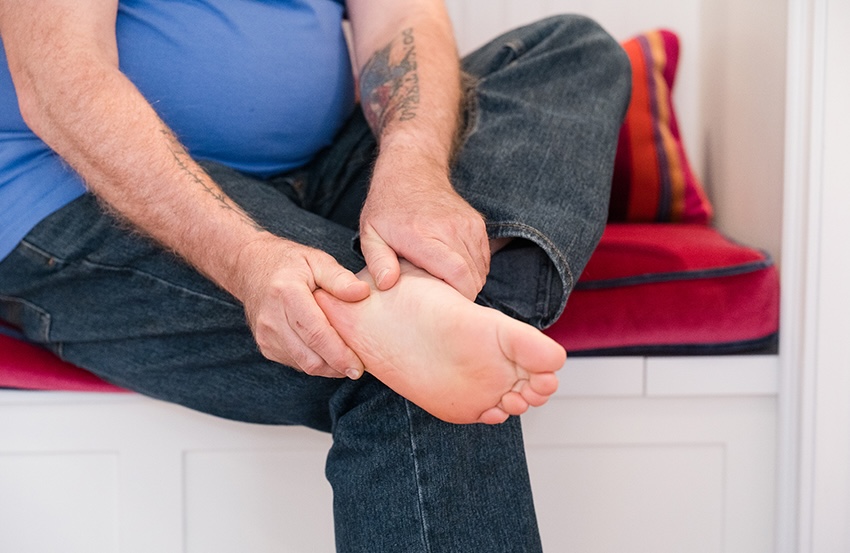
Have you ever sat cross-legged for too long and your foot gets that prickly, “pins and needles” feeling? Usually, you stand up, shake it off, and the feeling goes away in a few minutes.
But what if that feeling didn’t go away? What if that tingling, burning, or numbness in your hands and feet became something you felt every single day?
Many people dismiss these sensations as “just part of getting older.” But at Simply Southern Chiropractic Center, we cannot express strongly enough that numbness and tingling in your hands and feet are NOT normal signs of aging.
These sensations are actually your body’s alarm system telling you something isn’t quite right, and they are the typical first signs of peripheral neuropathy. If you are experiencing these sensations, you might be wondering what peripheral neuropathy actually is and how you can treat it naturally.
Today, we are going to break down exactly what the early signs of neuropathy are, what they mean, why they happen, and why you shouldn’t wait another day to get them checked out.
Table of Contents:
- What Are the Early Signs of Neuropathy?
- Why Do My Feet Tingle and Burn All the Time?
- What Causes Neuropathy in Your Feet and Legs?
- Can Nerve Damage Be Reversed if Caught Early?
- When Should I See Someone About Neuropathy?
- How Do You Treat Neuropathy Without Medication?
- Neuropathy Treatment Near Greenville, SC
What Are the Early Signs of Neuropathy?
Early signs of neuropathy usually include tingling, a burning sensation, sharp shooting pains, and extreme sensitivity to touch in the feet or hands. As it progresses, it can also cause partial numbness or a total loss of feeling.
Think of your nervous system as a massive communication network. This network is made up of different types of nerves, which you can visualize as being wires in the network. Some of these nerve wires are thick and control your heavy muscles. Others are microscopic, hair-thin nerve wires that rest just beneath your skin.
These delicate, hair-thin wires are called small fiber nerves. Their main job is to feel light touch, pain, and temperature. Because these small fibers are so tiny and fragile, they are usually the first things to get damaged when you develop neuropathy.
The most common early warning signs that these specific nerves are in trouble include:
- Tingling or “pins and needles” in your toes and fingers
- A burning sensation, especially at night
- Sharp, shooting pains that feel like an electric shock
- Numbness or a loss of feeling
- Extreme sensitivity to touch (like feeling pain just from a bedsheet resting on your feet)
Why Do My Feet Tingle and Burn All the Time?
Constant tingling and burning in your feet are often the first signs of peripheral neuropathy. This happens because the small fiber nerves at the furthest tips of your toes are damaged and are sending incorrect signals to your brain.
When those tiny, fragile nerves get damaged, they start misfiring. Think of it like trying to listen to the radio when you drive too far away from the broadcast station, but all you hear is static. Because small fiber nerves are in charge of feeling temperature and pain, your brain’s version of that “static” feels like a burning heat or a prickly “pins and needles” sensation.
Usually, these symptoms follow a very specific pattern. Doctors call it the “stocking and glove” pattern. The tingling begins at the very tips of your toes or fingers. Over time, it slowly creeps up your legs and arms, exactly like pulling on a pair of invisible socks or gloves.
If you are experiencing these sensations, it’s important to know the difference between widespread nerve damage and an isolated issue. You can learn more about whether your symptoms are from a pinched nerve, sciatica, or neuropathy here.
What Causes Neuropathy in Your Feet and Legs?
While there are over 100 different causes of neuropathy, unmanaged diabetes is the most common. High blood sugar damages the tiny blood vessels that supply oxygen to your nerves, causing the protective coating around the nerves to break down.
Research shows that neuropathy affects up to 7% of the general population, but that number skyrockets for people with blood sugar issues. In fact, up to 50% of people with diabetes will develop neuropathy at some point.
If we’re still imagining that your nerves are like electrical wires in our nervous system’s network, picture every wire as having a protective coating around it. When your blood sugar stays high, or if your body lacks proper nutrition, that protective coating gets damaged. This causes the misfiring, the burning, and the tingling sensations.
If the problem isn’t fixed, the damage goes deeper into your “large fiber” nerves. These are the nerves that control your muscles and balance. When the nerve “wire” itself begins to die back, the sensory symptoms (like going from a burning sensation in your toes) turn into motor symptoms (like physically losing your balance).
When these motor symptoms kick in, you might start feeling clumsy, lose your balance, feel weakness in your ankles, or feel like you are tripping over nothing. This happens because your brain literally no longer knows exactly where your feet are in space.
Can Nerve Damage Be Reversed if Caught Early?
Yes, if caught early enough, your nerves can be helped to heal. If we treat the problem while only the nerve’s protective coating is damaged, function can be restored. However, if the nerve wire itself dies back, the damage becomes permanent.
If we can catch the damage in the early stages, we can help your body heal. We can work to remove the interference, increase blood flow, and give your nerves the environment they need to repair themselves.
But if you ignore the tingling for years, the nerve will die back. Once that happens, you run the risk of serious balance issues, falls, and foot injuries that you can’t even feel.
When Should I See Someone About Neuropathy?
You should see a professional about neuropathy as soon as you notice recurring tingling, burning, or numbness in your extremities. Do not wait for the symptoms to turn into a total loss of feeling or balance issues.
This is the most important thing we want you to take away from this article: the earlier you catch neuropathy, the better. Don’t wait until the tingling turns into total numbness. It’s much easier to fix when you first see the signs.
If you aren’t sure where your symptoms stand, take a few minutes to complete our free Neuropathy Quiz to find out.
How Do You Treat Neuropathy Without Medication?
Because there are over 100 different reasons why nerves get damaged, natural neuropathy treatment involves finding your specific root cause rather than just covering up the pain. At Simply Southern Chiropractic Center, we use chiropractic care, Class IV Laser Therapy, home-based therapies, and nutritional support to help nerves heal from the inside out.
Living with tingling, burning, and nerve pain is exhausting. It drains your energy and keeps you from enjoying your life.
You might have been told that you just have to live with it, or that your only option is to take medications that simply mask the pain. We want you to know that you have other options. We don’t want to just cover up the static. We want to find the exact root cause of the interference.
Neuropathy Treatment Near Greenville, SC
You deserve to feel comfortable in your body again. It’s never too late to start taking better care of yourself, and you don’t have to navigate this pain alone.
Our team at Simply Southern Chiropractic Center is dedicated to providing holistic, root-cause care for patients struggling with nerve pain. With clinics in both Greenville and Greer, SC, our unique Neuropathy Program is designed to bring you natural, lasting relief.
Ready to get some real answers about what’s going on with your nerves?
Schedule your neuropathy evaluation at Simply Southern Chiropractic Center today.
References
Azhary, H., Farooq, M. U., Bhanushali, M., Majid, A., & Kassab, M. Y. (2010). Peripheral neuropathy: differential diagnosis and management. American family physician, 81(7), 887–892. https://pubmed.ncbi.nlm.nih.gov/20353146/
Castelli, G., Desai, K. M., & Cantone, R. E. (2020). Peripheral Neuropathy: Evaluation and Differential Diagnosis. American family physician, 102(12), 732–739. https://pubmed.ncbi.nlm.nih.gov/33320513/
Hammi C, Yeung B. Neuropathy. [Updated 2022 Oct 15]. In: StatPearls [Internet]. Treasure Island (FL): StatPearls Publishing; 2026 Jan-. Available from: https://www.ncbi.nlm.nih.gov/books/NBK542220/
Misra, U. K., Kalita, J., & Nair, P. P. (2008). Diagnostic approach to peripheral neuropathy. Annals of Indian Academy of Neurology, 11(2), 89–97. https://doi.org/10.4103/0972-2327.41875
Cleveland Clinic. (2022, August 10). Peripheral neuropathy. https://my.clevelandclinic.org/health/diseases/14737-peripheral-neuropathy
Houston Methodist. (2024, March 14). What are the early warning signs of neuropathy? https://www.houstonmethodist.org/blog/articles/2024/mar/what-are-the-early-warning-signs-of-neuropathy/
Yale Medicine. (n.d.). Neuropathy. Retrieved April 21, 2026, from https://www.yalemedicine.org/conditions/neuropathy