
Achy Neck, Shoulders, and Back After Working All Day? You May Have Upper or Lower Crossed Syndrome
Key Points
- Upper Crossed Syndrome (UCS) and Lower Crossed Syndrome (LCS) are postural imbalances often caused by improper ergonomic working environments, like sitting at a desk or bending over all day.
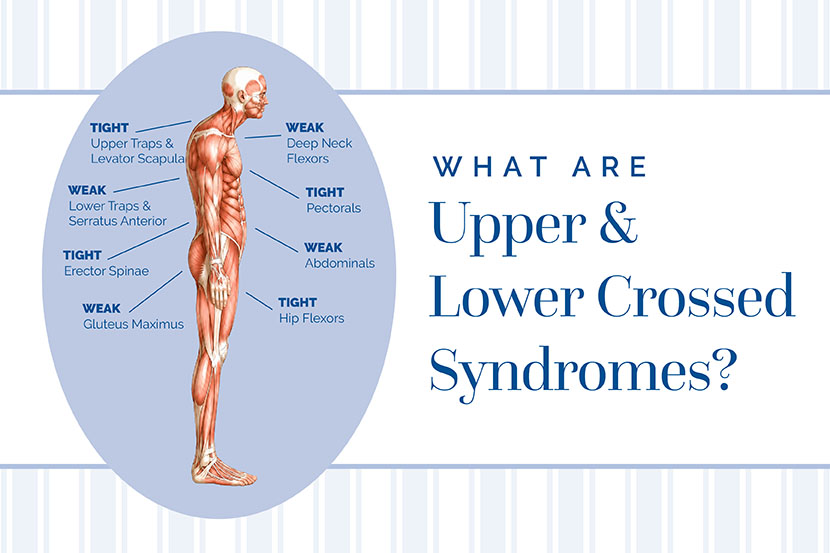
- In both conditions, specific muscles get chronically tight while opposing muscles become stretched and weak, forming an “X” or “crossed” pattern of imbalance.
- Upper crossed Syndrome affects the upper body, specifically the neck and shoulders, leading to forward head posture, rounded shoulders, neck pain, and even tingling in the arms.
- Lower crossed Syndrome affects the lower body, causing an anterior pelvic tilt that pinches the lower back joints and causes chronic pain.
- Stretching alone will not fix the problem if your joints are locked. Treating these syndromes requires unlocking the joints with chiropractic adjustments and retraining the muscles with corrective exercises.
Do you ever feel like you physically cannot sit up straight at the end of a long workday? Or maybe your lower back constantly aches after doing basic household chores? It’s a more common issue than you might think.
Many people who experience these symptoms assume they just have bad posture or that aching joints are a normal part of getting older. But the reality is, your body is actually making a physical adaptation due to poor ergonomics.
When you spend hours in the same position every day, your body literally changes its shape to match that position. Two of the most common ways this happens are called Upper crossed Syndrome and Lower crossed Syndrome.
These syndromes can cause daily pain, discomfort, and even physical limitations—but the good news is that they are highly treatable, especially when caught early. Keep reading to learn exactly how these crossed patterns show up in your body and what steps you can take to finally find relief.
Table of Contents:
- What Is a Crossed Posture Syndrome?
- What Is Upper Crossed Syndrome?
- Why Does My Neck Ache After Sitting at My Desk All Day?
- What Is Lower Crossed Syndrome?
- Why Does My Lower Back Hurt When I Stand?
- How Do You Fix Upper and Lower Crossed Syndromes?
- Realign Your Joints and Muscles with Chiropractic Care
What Is a Crossed Posture Syndrome?
A crossed posture syndrome happens when you spend too much time in one position, causing some muscles to get chronically tight and short, while the opposing muscles become overstretched and weak.
Think of your body and everything happening under your skin like a game of tug-of-war. Your bones and joints are stuck right in the middle. When the muscles on one side of a joint get too tight, they pull constantly. The muscles on the other side get stretched out and weak, meaning they lose the battle and cannot pull your body back into proper alignment.
When we examine these muscular imbalances during a chiropractic appointment, it becomes clear that these tight and weak muscles always form an “X” or crossed pattern across the body.
What Is Upper Crossed Syndrome?
Upper crossed Syndrome is a muscular imbalance in the upper body where the chest and front neck muscles are too tight, and the mid-back and deep neck muscles are too weak. If you sit at a desk all day and experience constant neck and back pain, you’re likely experiencing Upper Crossed Syndrome, sometimes also referred to as Tech Neck or Text Neck.
In Upper Crossed Syndrome, the pullers in this tug-of-war are your chest muscles (the pectorals) and your upper shoulder and neck muscles. Because you likely spend most of your day hunched over a keyboard or sitting in an unsupportive desk chair, these muscles become shortened and locked up over time.
The stretchers in the tug-of-war are the muscles between your shoulder blades, like your rhomboids and lower traps, as well as the deep muscles in the front of your neck. Over time, these weak muscles give up, leading to what doctors call “forward head posture” and noticeably rounded shoulders.
Why Does My Neck Ache After Sitting at My Desk All Day?
Sitting hunched over a desk for hours forces your neck to carry the weight of your head at an unnatural angle, causing extreme tension in your upper back and neck muscles. Lots of people experience this deep back and neck pain after sitting at their desks all day—especially in our modern, often remote and desk-work-oriented society—and typically assume the issue is originating from their neck or back. However, it’s really coming from those tight chest muscles pulling the shoulders forward and into misalignment.
This muscle imbalance doesn’t just manifest in poor posture or looks; it causes real, physical pain. When your head is pushed forward, the muscles in your neck have to work overtime to hold it up. So, instead of carrying the typical weight of your head, around 10–12 pounds, the strain on your neck can jump to over 40 pounds.
This can lead to symptoms like:
- Chronic mid-back pain
- Neck tightness or stiffness
- Frequent tension headaches
Beyond just the physical discomfort, being constantly hunched over can also restrict your breathing, disrupt your sleep, and drain your energy.
In severe cases of Upper Crossed Syndrome, the tight muscles in your neck and chest can even pinch nerves, leading to tingling or numbness in your arms. If you’re experiencing persistent tingling or numbness of any kind in your fingers, hands, or arms, it’s important to look into the early signs of neuropathy, as treating the root cause early is crucial.
What Is Lower Crossed Syndrome?
Lower Crossed Syndrome is a muscular imbalance in the pelvis where the hip flexors and lower back muscles are too tight, while the abdominals and glutes are too weak. Just like the upper body, excessive sitting locks the lower body into an “X” pattern.
When you sit, the muscles on the front of your hips (your hip flexors) are constantly shortened. Meanwhile, your glutes and the muscles on the back of your legs (your posterior chain) are constantly stretched and become weak.
Think of your pelvis like a bowl of water. When your hip flexors get too tight, they pull the front of the pelvis down. When your glutes and abs are constantly lengthened and become weak, they’re not strong enough to pull your pelvis back up and into alignment. Because of this, your pelvis tips forward, “spilling the water” out the front of the bowl. This is called anterior pelvic tilt, and it can create a very deep, unnatural arch in your lower back, also known as swayback.
Why Does My Lower Back Hurt When I Stand?
When your pelvis tips forward in Lower Crossed Syndrome, it pinches the very bottom joints of your spine, specifically the L4-L5, L5-S1, and sacroiliac (SI) joints. This constant pinching and joint stress is exactly why your lower back aches when you try to stand up straight or walk after sitting for a long time.
While some might think that only desk workers experience Lower Crossed Syndrome, the truth is that anyone with consistently poor ergonomics can develop it. Even people with highly active jobs, like cleaners or even teachers, develop Lower Crossed Syndrome from constantly bending forward.
How Do You Fix Upper and Lower Crossed Syndromes?
Fixing both Upper and Lower Crossed Syndromes starts with a two-step approach: clinically unlocking the restricted joints, and performing specific corrective exercises to stretch the tight muscles and strengthen the weak ones.
Many people try to fix their posture by simply trying to sit up straight or doing a few stretches at home. While it is definitely important to take care of your spine and joints at work and at home, it’s not the full solution to healing these symptoms.
The reality is that if your joints are physically locked out of alignment, stretching alone won’t do much for you. In fact, it might even cause more pain. This is why hands-on therapies, like chiropractic and corrective exercise, are needed to reset the body.
A comprehensive approach to healing involves inhibiting and lengthening tight muscles, activating and strengthening weak muscles, and integrating each muscle group back into daily movements. For example, if you sit at a desk all day, doing an exercise like a simple glute bridge at home is a great way to wake up the posterior chain muscles that fall asleep while you sit and can cause Lower Crossed Syndrome.
Realign Your Joints and Muscles with Chiropractic Care
Living with Upper or Lower Crossed Syndrome can feel like your body is constantly fighting against itself. You deserve to feel comfortable, and you do not have to navigate this alone. For lasting relief, you need professional care that treats the root cause, addressing your environment, lifestyle, ergonomics, muscles, and joints.
At Simply Southern Chiropractic Center, we believe in real healthcare for real people. We never just adjust your spine and send you home. We use gentle adjustments to restore proper movement to your locked joints, and then guide you through the exact rehabilitation exercises needed to wake up your weak muscles.
Are you ready to stop the tug-of-war and finally find relief from neck and back pain?
Schedule a chiropractic appointment at Simply Southern Chiropractic Center today, and let us help you get back to feeling like yourself.
References
Burile, G., Phansopkar, P., & Deshmukh, N. S. (2024). Prevalence of Lower Crossed Syndrome in Housemaids. Cureus, 16(4), e57425. https://doi.org/10.7759/cureus.57425
Chang, M. C., Choo, Y. J., Hong, K., Boudier-Revéret, M., & Yang, S. (2023). Treatment of Upper Crossed Syndrome: A Narrative Systematic Review. Healthcare (Basel, Switzerland), 11(16), 2328. https://doi.org/10.3390/healthcare11162328
Chaudhuri, S., Gupta, M., Phadke, V., & Chawla, J. K. (2024). Conceptual Framework of Upper Crossed Syndrome: A Delphi Study. Cureus, 16(8), e67873. https://doi.org/10.7759/cureus.67873
National Academy of Sports Medicine. (n.d.). Lower Crossed Syndrome. NASM Blog. Retrieved from https://blog.nasm.org/lower-crossed-syndrome
Lower Crossed Syndrome. (2025, October 6). Physiopedia. Retrieved April 2026 from https://www.physio-pedia.com/index.php?title=Lower_crossed_Syndrome&oldid=372587.